
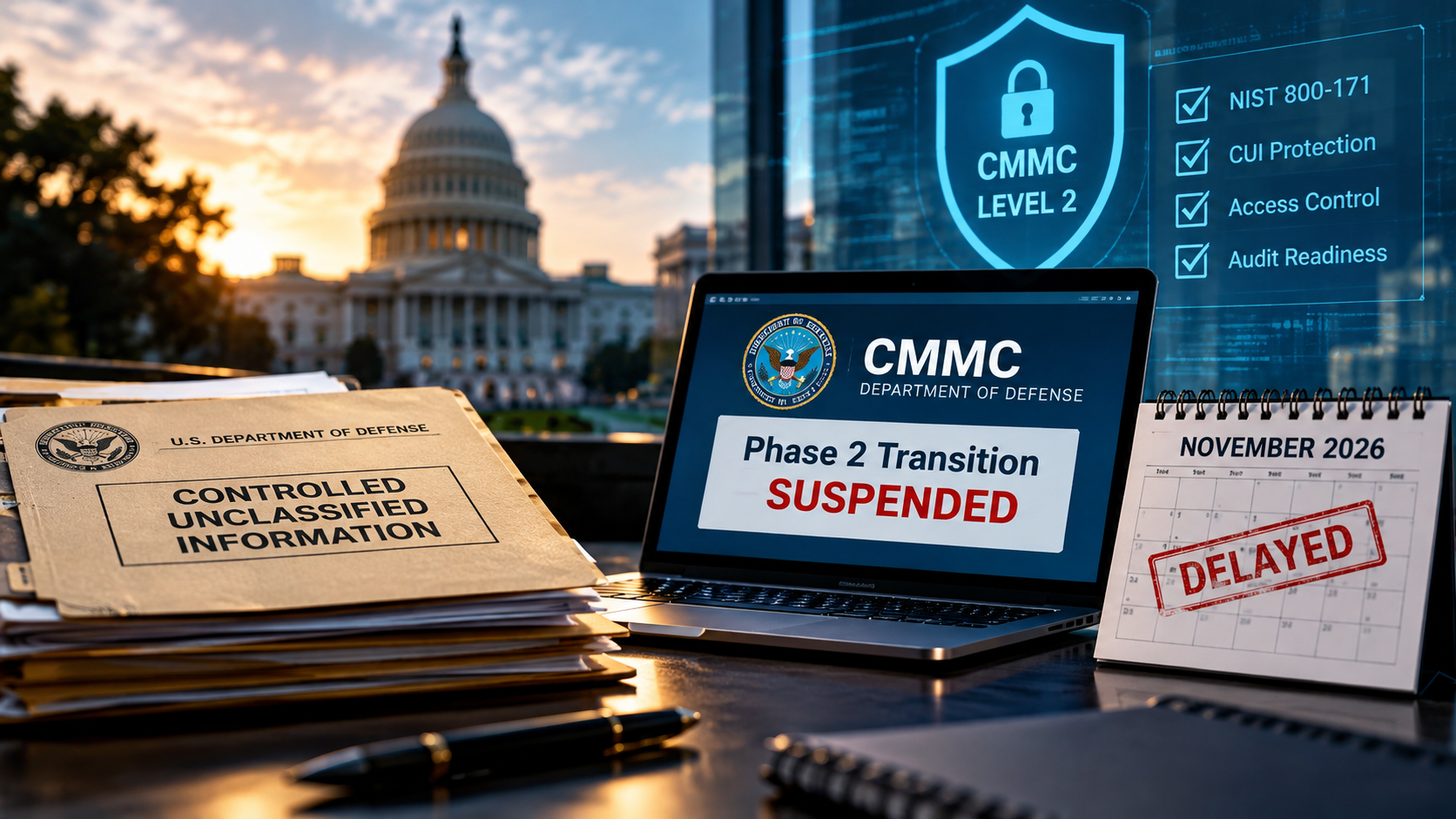
Over the last year, defense contractors have been racing toward what many believed was a hard November 2026 deadline for CMMC Level 2 third-party assessments.
For organizations handling Controlled Unclassified Information (CUI), the expectation was straightforward: prepare for a Certified Third-Party Assessment Organization (C3PAO) audit or risk losing eligibility for future Department of Defense opportunities.
Recently, the Department of Defense announced a suspension of the planned Phase 2 transition while it conducts a broader review of the CMMC program.
For many organizations, this sounds like good news.
And it is.
But it is equally important to understand what has not changed.
What Was Delayed?
Prior to the recent announcement, Phase 2 of the CMMC rollout was scheduled to begin in November 2026. Under that phase, Level 2 third-party assessments were expected to become the default requirement for many contracts involving CUI.
The Department of Defense has now suspended that planned transition while it reviews the program. As a result, contractors that were preparing for a near-term C3PAO assessment may have additional time before third-party certification requirements are broadly implemented.
For organizations concerned about auditor availability, remediation timelines, budget constraints, or staffing limitations, the announcement provides welcome breathing room.
What Has Not Changed?
The most important takeaway is that the underlying cybersecurity requirements have not gone away.
Organizations handling CUI are still expected to comply with NIST SP 800-171 requirements and existing DFARS cybersecurity obligations. The recent development primarily affects the timing of third-party assessments—not the expectation that contractors properly secure sensitive government information.
In other words:
The audit may be delayed. The security requirements are not.
Companies that assume CMMC has been cancelled or abandoned entirely could find themselves scrambling if future solicitations once again require evidence of compliance.
Why This May Actually Be Good News
For organizations pursuing defense contracts, the delay creates an opportunity to be more strategic.
One of the biggest mistakes we see companies make is treating CMMC as an audit project rather than a cybersecurity program.
When organizations rush toward a compliance deadline, they often make expensive decisions:
- Bringing far more users and systems into scope than necessary
- Deploying controls without fully understanding their environment
- Creating policies and procedures that do not align with operational reality
- Purchasing tools before defining the actual compliance boundary
- Overengineering solutions that increase cost without improving security
The additional time now available allows organizations to focus on compliance architecture rather than deadline management.
The Real Cost Driver: Scope
For most Level 2 organizations, the single largest factor influencing both cost and complexity is scope.
The question is not:
“How do we make the entire company CMMC compliant?”
The better question is:
“Who actually needs access to CUI?”
In many organizations, only a small subset of employees work on government contracts or handle information that falls within the CMMC boundary.
For engineering firms, manufacturers, software developers, and defense subcontractors, identifying those users early can dramatically reduce compliance costs.
A smaller boundary means:
- Fewer users
- Fewer endpoints
- Fewer servers
- Fewer applications
- Less monitoring
- Less documentation
- Simpler audits
Most importantly, it creates an environment that is easier to explain, secure, manage, and defend during an assessment.
Why We Continue to Recommend an Enclave Model
At ECW, our preferred approach for many Level 2 organizations is to establish a dedicated compliance enclave rather than attempting to bring the entire business into scope.
Under this model:
- CUI remains inside a dedicated environment
- Government-related email remains inside that environment
- Government-related files remain inside that environment
- Government collaboration remains inside that environment
- Users access sensitive information through controlled and monitored systems
- Access is tightly governed, logged, and auditable
Rather than forcing every employee, workstation, and application into the CMMC boundary, organizations can focus their resources where they matter most.
This approach often provides the best balance between security, compliance, operational efficiency, and cost control.
Waiting Is Still a Risk
Some organizations may view the recent announcement as justification to pause compliance efforts altogether.
That would be a mistake.
When CMMC requirements eventually continue their rollout, organizations that delayed planning will likely face the same challenges they were facing before:
- Limited remediation time
- Budget pressures
- Resource constraints
- Documentation gaps
- Policy deficiencies
- Auditor scheduling bottlenecks
Meanwhile, organizations that use this additional time effectively can enter the next phase of implementation substantially ahead of their peers.
The Competitive Advantage Few Contractors Are Considering
Most companies view compliance purely as a cost.
The contractors that consistently win government work tend to view compliance differently.
A well-designed CMMC program demonstrates operational maturity, cybersecurity discipline, and risk management capabilities that many competitors lack.
When requirements ultimately become contractual obligations, organizations that invested early will already have:
- A defined CUI boundary
- Established policies and procedures
- Trained personnel
- Implemented technical controls
- Completed gap remediation
- Collected evidence necessary for assessment
Those organizations will be positioned to pursue opportunities while others are still trying to figure out where their CUI resides.
Final Thoughts
The recent CMMC announcement is positive news for many contractors. It provides additional time, greater flexibility, and an opportunity to approach compliance more strategically.
However, it should not be interpreted as a cancellation of cybersecurity obligations or a signal that CMMC is going away.
The timeline may have shifted.
The destination has not.
Organizations that use this period to properly define their CUI boundary, reduce scope, remediate deficiencies, and implement a practical compliance architecture will be in a far stronger position when the Department of Defense finalizes the next phase of the program.
The deadline moved. The requirement did not.
Recent Posts


How can we help?
Whether you need immediate help with an IT issue or want to discuss your long-term IT strategy, our team is here to help.
Call us at (561) 303-2310 or complete the form below and we'll help in any way we can.